![blo[g]ck del dr hinkfuss](https://blogger.googleusercontent.com/img/b/R29vZ2xl/AVvXsEgyQvMaBlx6rZT87bZAAVI7mPihqj5rpmE3bVLk4DhqPD2SpYLCv2ycayOJnvhFZDhRje1CIbsOCuyJYenYovEKNoOmAViC7hLUpwcQ474SYTA8dE5KH76TQ3msUQBmTRtnY_JGt04IXzQ/s1600/cabecera2.jpg)

Try to picture an art piece that cannot be put in a museum, purchased by wealthy collectors, or displayed in a corporate foyer or boardroom – because it disintegrates in less than a day, perhaps even within 20 seconds. Try to imagine executing artwork through the medium of iron oxide chalk, raw sheep’s wool, flower blossoms, leaves and grass, feathers, random sticks and stones, broken rocks, pieces of icicle, green iris blades and red berries, thorns, bracken, or handfuls of snow. Try to fathom the notion that an artist could a take stroll in the woods, along a riverbank, down a beach, and with no tools at all – no paint brushes, no sculptor’s chisels or knives, no canvases or pedestals or quarried granite or polished wood – manage to create unutterably beautiful art from the objects and materials he finds by chance.
Often it seems that contemporary art has become a largely academic exercise, with artists frantically carving out tiny niches of discrete subject matter or distinctive media in which to say something, show something faintly “original.” But for more than two decades, Scottish sculptor Andy Goldsworthy has quietly been blowing that notion to smithereens. He’s the visual art world’s equivalent of Italo Calvino, who celebrated the wide-open choices available to him as a writer of short stories and novels while others lamented the death of the novel. Goldsworthy calmly demonstrates over and over that the forms, styles, and media available to the artist are approximately infinite.
In the documentary by German filmmaker Thomas Riedelsheimer, we watch Goldsworthy build man-sized standing “eggs” of stacked slate on a beach between tides; place a 50-foot spiral “worm” of leaves sewn together with grass in a pond, whence it begins to wend its way down a mountain stream; gnaw at icicle shards in order to piece them into a looping snake that seems to pass repeatedly through a stone promontory like a fat crystal thread; construct an “igloo” of driftwood that is carried away by the incoming tide in a stately galactic whirl.
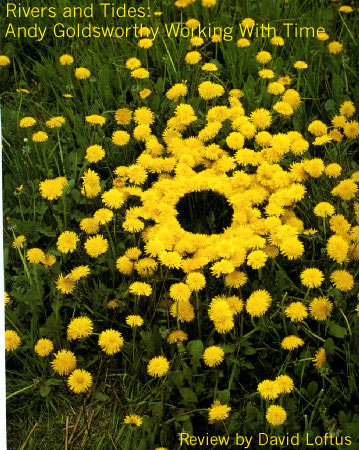
Try to picture an art piece that cannot be put in a museum, purchased by wealthy collectors, or displayed in a corporate foyer or boardroom – because it disintegrates in less than a day, perhaps even within 20 seconds. Try to imagine executing artwork through the medium of iron oxide chalk, raw sheep’s wool, flower blossoms, leaves and grass, feathers, random sticks and stones, broken rocks, pieces of icicle, green iris blades and red berries, thorns, bracken, or handfuls of snow. Try to fathom the notion that an artist could a take stroll in the woods, along a riverbank, down a beach, and with no tools at all – no paint brushes, no sculptor’s chisels or knives, no canvases or pedestals or quarried granite or polished wood – manage to create unutterably beautiful art from the objects and materials he finds by chance.(...) sigue aquí


No hay comentarios:
Publicar un comentario